The Franklin Delano Roosevelt Memorial is unlike any other on the National Mall: instead of a single dome or statue, it unfolds as four open-air 'rooms' you walk through one after another, each standing for one of FDR's four terms in office from 1933 to 1945. Set along the western edge of the Tidal Basin, it's a slow, immersive sequence of red granite walls, cascading waterfalls, quiet alcoves, and bronze sculptures. Plan on roughly 30 to 45 minutes at an unhurried pace, and longer if you stop to read the carved quotations—which is really the point of the place.
It's also one of the easiest big memorials to enjoy without a crowd. Because it sprawls horizontally rather than rising into a landmark you can spot from afar, plenty of visitors walk right past it on their way to the Jefferson or Lincoln. That's good news for you: the FDR Memorial rewards people who slow down.
The Short Answer: What You're Walking Through
Each of the four rooms corresponds to one of Roosevelt's presidential terms, and together they trace America's path through the Great Depression and World War II. As you move from room to room, the mood shifts with the history—from hardship and the New Deal to wartime resolve and, finally, hope and remembrance. The waterfalls grow larger and more turbulent as the story moves toward the war years, a deliberate design touch you'll feel more than notice.
The memorial is open-air and at ground level, so there are no tickets, no timed entry, and no stairs to climb. You simply walk in and keep going. Like the other memorials on the Mall, it's open 24 hours and lit at night, which makes it a genuinely different experience after dark.
Room by Room: FDR's Four Terms
The first room sets the scene with FDR's 1933 inauguration and his most famous line, 'The only thing we have to fear is fear itself.' It's the quietest of the four, a gentle introduction before the history deepens.
The second room is where the Depression hits home. Here you'll find the memorial's most photographed bronzes: a row of careworn men waiting in a Depression-era breadline, and a figure listening to one of FDR's radio 'fireside chats.' They're life-sized and at street level, so you can stand shoulder to shoulder with them—exactly what the sculptors intended.
The third room turns to World War II. The waterfalls here are at their most powerful, tumbling over broken granite blocks to evoke the upheaval of the war years. A large seated statue of Roosevelt, his Scottish terrier Fala at his side, anchors this section, alongside the carved words 'I hate war.'
The fourth and final room is about loss and legacy. It honors FDR's death in 1945 and includes a statue of Eleanor Roosevelt before the emblem of the United Nations—often noted as the first presidential memorial to include a First Lady. A still, reflective pool closes the walk on a note of calm.
Near the entrance, look for the statue of FDR seated in a wheelchair, added after the memorial first opened in response to advocates who wanted his disability honestly represented. For many visitors it has become one of the most meaningful stops.
Finding It on the Tidal Basin
The FDR Memorial sits on the southwest shore of the Tidal Basin, in the same cluster as the Martin Luther King, Jr. Memorial and the Jefferson Memorial. The most scenic approach is to walk the Tidal Basin path from either neighbor; the three flow naturally into one loop on foot.
There isn't a Metro stop at the doorstep. The Smithsonian station is the closest stop to the Mall, and from there it's a pleasant walk down past the Washington Monument and around the water to reach FDR. If you're piecing together a self-guided day, our trip planner can help you sequence the Tidal Basin memorials so you're not doubling back.
When to Go
Spring is the showstopper. Cherry blossoms typically peak from late March to early April around the Tidal Basin, and the memorial's waterside setting puts it right in the bloom. It's also the busiest window, so arrive early in the morning if you want the rooms mostly to yourself.
If you can only visit once, consider going at night. The memorials on the Mall are lit after dark, and the FDR's waterfalls and granite walls take on a hushed, almost private feeling when the day crowds have thinned. A guided evening memorials walk is a comfortable way to see it lit up without navigating the unlit paths between sites on your own.
Don't Miss These Details
Reach out and touch the bronzes. Unlike statues roped off behind barriers, FDR's sculptures are meant to be approached, and the breadline figures in particular are worn smooth where countless hands have rested on them.
Read at least a few of the carved quotations. The walls are inscribed with Roosevelt's own words, and they're the soul of the memorial. If you read only one, make it 'I hate war' in the third room.
Listen for the water. Each room's waterfall is tuned to its era's mood, so notice how the sound changes as you move from the calm of the first room to the crashing falls of the war years.
Pairing FDR With the Rest of the Mall
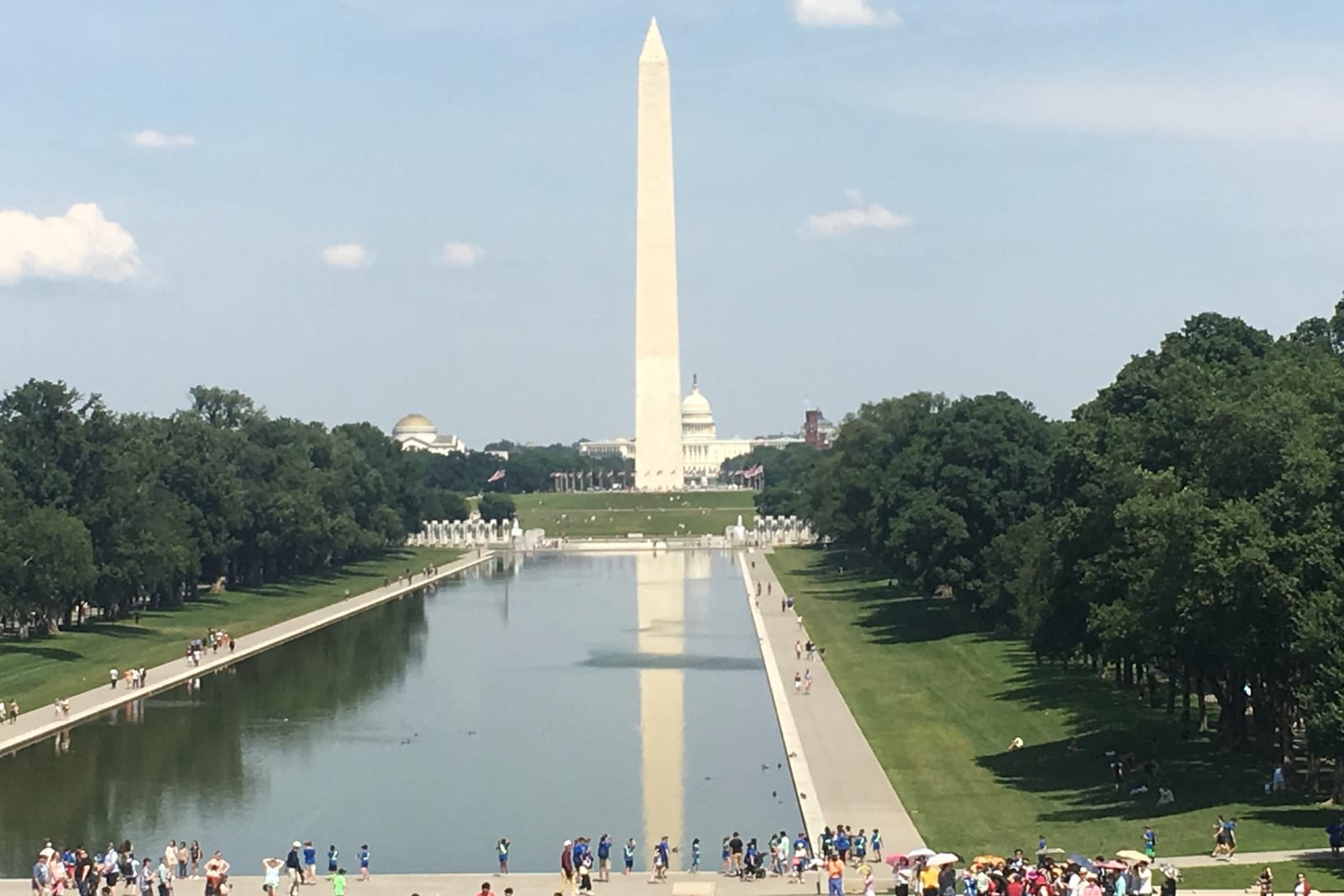
The FDR Memorial is best experienced as part of a memorials walk rather than a single stop. From the Tidal Basin you're a short stroll from the Jefferson and MLK memorials, and a slightly longer walk delivers you to the Lincoln Memorial at the far west end of the Mall, which runs roughly two miles from the U.S. Capitol. Many visitors fold in a trip up the 555-foot Washington Monument, reached by a timed ticketed elevator; if that's on your list, line up Washington Monument tickets ahead of time, since timed passes go fast.
The catch is logistics. The memorials are spread out, the connecting paths aren't always obvious, and the stories behind each one are easy to miss without context. That's where a guided walk earns its keep.
Make It Easy With a Guided Walk
If you'd rather absorb the history than read a map, our Washington DC Memorials Guided Walking Tour covers the Mall's headline memorials with a local guide in about 1.5 hours, from $69.99. A guide handles the route, points out details like FDR's wheelchair statue, and ties the four rooms into the larger American story so the memorial lands the way its designers intended. It's an efficient, warm way to see FDR alongside its Tidal Basin neighbors without losing the thread.
However you visit, give the FDR Memorial more time than you think you need. Of all the monuments in Washington, it's the one that asks you to walk slowly—and it gives the most back when you do.
Frequently asked questions
How long does it take to walk through the FDR Memorial?+
Is the FDR Memorial free to visit?+
What do the four rooms at the FDR Memorial represent?+
How do I get to the FDR Memorial on the Metro?+
Book These Tours
Plan your day in Washington DC
Build a non-overlapping day of monument tours, memorials, and Arlington — then book it all in one checkout.
Open the DC Day Planner →