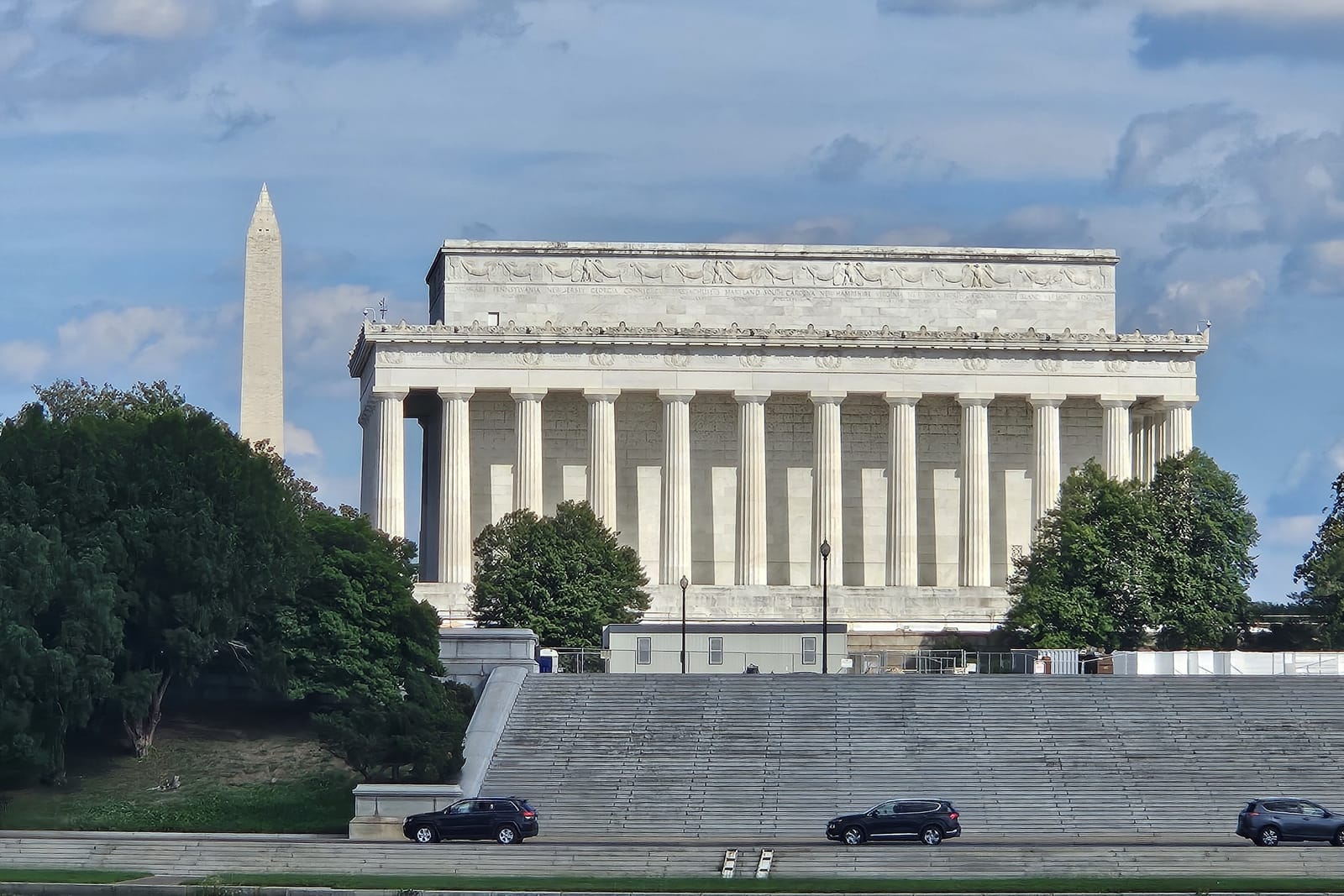
The World War II Memorial sits squarely at the center of the National Mall, between the Washington Monument to the east and the Lincoln Memorial Reflecting Pool to the west. It is free, open 24 hours, and lit at night. At its heart is an oval plaza built around a fountain pool, framed by 56 granite pillars and two tall arched pavilions — a design meant to gather people in rather than tower over them. This guide walks you through what each part means, when to come, and how to fold the memorial into a full day on the Mall.
Finding the Memorial and Reading Its Layout
The memorial occupies the ground between the Washington Monument and the Reflecting Pool, so you will pass it naturally whether you start at the Capitol end or the Lincoln end of the Mall's roughly two-mile stretch. The closest Metro stop is Smithsonian station, a short, flat walk away. Many visitors reach the memorial mid-stroll without ever planning to, because it sits right on the line everyone walks.
Step into the plaza and the geometry makes sense quickly. The space is a gently sunken oval — you descend a few low steps — with a fountain pool at the middle. Two large arched pavilions stand at the north and south ends, and a curving colonnade of stone pillars wraps the rest. A ceremonial entrance with bronze reliefs leads in from the 17th Street side. Because the bowl sits slightly below grade, the noise of the city drops away and the sound of moving water takes over.
Decoding the 56 Pillars
The 56 granite pillars are the feature most visitors ask about. Each is inscribed with the name of a U.S. state or territory as it stood during the war — the 48 states of that era, the District of Columbia, and territories including Alaska, Hawaii, Puerto Rico, and the Philippines. They run in the order each entered the Union rather than alphabetically, which is why the sequence looks scrambled at first.
Bronze wreaths hang on each pillar, and bronze ropes link them together, a deliberate symbol of national unity during the war years. Finding your home state's pillar is one of the small, personal rituals of a visit. A guide can point you straight to it and explain the ordering, which is easy to miss on your own.
The Pavilions, the Fountains, and the Freedom Wall
The two arched pavilions mark the war's great theaters: "Atlantic" to the north and "Pacific" to the south. Inside each, bronze eagles hold a victory laurel, and a World War II victory medal is set into the floor. They bracket the memorial like bookends to the conflict.
The fountains are its emotional center. Water jets play in the main pool and spill from basins at the foot of each pavilion, and on a hot DC afternoon the sound and spray are genuinely cooling. Along the western edge is the Freedom Wall, a field of gold stars where each star honors a hundred Americans who died. Standing before it is the quietest moment in the memorial. Look closely around the perimeter, too, and you may spot a small engraved "Kilroy Was Here" — the GI graffiti that traveled the world with American troops.
When to Visit, and Why Night Is Worth It
The memorial is open and lit around the clock, so there is no wrong time, but the light changes everything. Mornings are calm and ideal for photos with the Washington Monument rising behind the pillars. Midday brings the biggest crowds and the fullest sun on the white granite. If you visit in late March or early April, the cherry blossoms around the nearby Tidal Basin typically peak, and the whole area is at its most beautiful.
After dark, the Mall transforms. The pillars glow, the fountains are underlit, and the Lincoln Memorial and Washington Monument frame the scene. A guided Washington DC Night Memorials Walking Tour with Skyline View, from $59.99 and running about two hours, is the easiest way to see the memorials at their most atmospheric without navigating the dark grounds alone, and the skyline views are a bonus you will not get at midday.
Walking It as Part of the Mall
Few people visit the World War II Memorial in isolation — it is one beat in a chain of monuments. From here it is a flat, scenic walk west along the Reflecting Pool to the Lincoln Memorial, with the Vietnam Veterans Memorial and the Korean War Veterans Memorial just off to either side, and the Martin Luther King, Jr. and Franklin Delano Roosevelt memorials around the Tidal Basin to the south.
Doing this loop on your own is easy enough, but the threads connecting the sites are simple to miss. A Washington DC Memorials Guided Walking Tour, from $69.99 and about 1.5 hours, strings the major memorials together with the context that makes them land and keeps you from backtracking. If you would rather map your own route first, sketch it out with our trip planner. To go higher, the Washington Monument stands right next door, and its timed-ticket elevator climbs all 555 feet for an overhead view of the layout you just walked.
Tips for a Better Visit
A few small things make the stop smoother. Wear comfortable shoes — the Mall is long and the plaza is all hard granite — and bring water in summer, since shade is limited around the open bowl. Smithsonian station is the closest Metro stop, and the nearby Smithsonian museums are free if you want to round out the day indoors. Give the memorial itself 20 to 30 minutes, more if you are reading inscriptions or hunting for your state's pillar.
The memorial also pairs naturally with Arlington National Cemetery, across the Potomac in Virginia, which has its own stop on the Metro's Blue Line. An Arlington tour rounds out a day built around remembrance, and the Changing of the Guard at the Tomb of the Unknown Soldier takes place every hour, and every half hour in summer. However you come, save a few quiet minutes for the Freedom Wall. The pillars and fountains are grand, but that field of gold stars is the part most people carry home.
Frequently asked questions
What do the 56 pillars at the World War II Memorial represent?+
Is the World War II Memorial free to visit?+
How long should I spend at the World War II Memorial?+
Can I see the World War II Memorial at night?+
Book These Tours
Plan your day in Washington DC
Build a non-overlapping day of monument tours, memorials, and Arlington — then book it all in one checkout.
Open the DC Day Planner →